


As of July 8, 2026, importers of certain regulated consumer products must electronically submit their certificates of compliance to the U.S. Consumer Product Safety Commission (CPSC). This new requirement is part of the CPSC’s eFiling program and changes how product safety certification information is provided during the U.S. import process.
Although the underlying testing and certification requirements have existed for years, the certificate information must now be transmitted electronically and linked directly to the customs entry.
What Is CPSC eFiling?
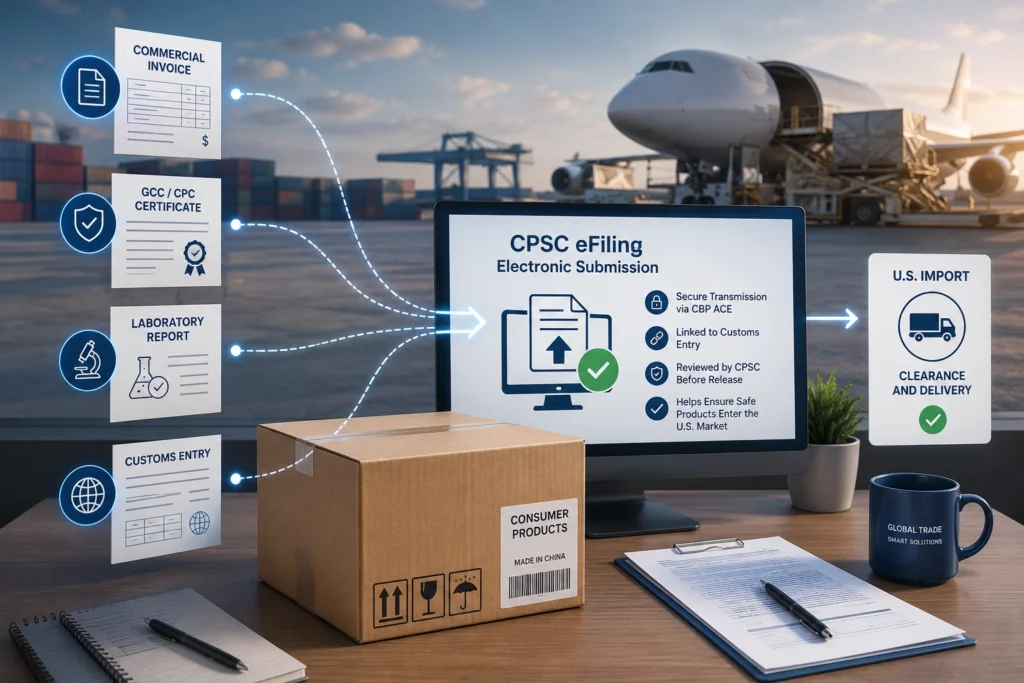
CPSC eFiling is the electronic transmission of certificate data through U.S. Customs and Border Protection (CBP). The information is submitted using the CPSC Partner Government Agency (PGA) Message Set within the Automated Commercial Environment (ACE).
This process allows the CPSC to receive and review product compliance information before goods enter U.S. commerce. The objective is to identify potentially unsafe products more efficiently while facilitating the clearance of compliant shipments.
Which Products Are Covered?
The requirement does not apply to every consumer product. In general, it applies to imported products that are subject to mandatory CPSC regulations and require one of the following certificates:
- Children’s Product Certificate (CPC): Required for children’s products subject to mandatory federal safety standards.
- General Certificate of Conformity (GCC): Required for certain general-use consumer products subject to mandatory CPSC regulations.
Examples of products that may fall within these requirements include toys, children’s furniture, strollers, bicycle helmets, cigarette lighters, wearing apparel, carpets, batteries, electrical products, and many other regulated consumer products.
However, a product’s general description or tariff classification alone does not determine whether certification is required. The determination depends on the product’s intended use, design, composition, target consumer, applicable regulations, and other factors.
What Information Must Be Submitted?
Depending on the product and the applicable regulation, the certificate information may include:
- Product identification.
- Name of the manufacturer, importer, or certifying party.
- Applicable safety regulations.
- Date and place of manufacture.
- Date and location of the compliance testing.
- Testing laboratory information, when applicable.
- Contact information for the individual responsible for maintaining the compliance records.
The information submitted should be consistent with the commercial documentation, laboratory reports, and customs entry data.
Who Is Responsible for Compliance?
The importer is ultimately responsible for determining whether a product requires certification and for ensuring that the information submitted is accurate. Although a customs broker may transmit the data through ACE, the broker generally relies on the information provided by the importer.
For that reason, compliance should not be delegated entirely to the customs broker. Before shipping, importers should verify:
- Whether the product is regulated by the CPSC.
- Which safety standards apply.
- Whether a CPC or GCC is required.
- Whether all required testing has been completed.
- Whether the testing laboratory must be CPSC-accepted.
- Whether all information necessary for eFiling is available.
- Whether the customs broker is prepared to transmit the CPSC PGA Message Set.
Does the Requirement Apply to Low-Value Shipments?
Yes. If a product requires certification, the eFiling requirement may also apply to Section 321 (de minimis) shipments. The fact that a shipment is valued below the de minimis threshold does not automatically exempt it from applicable product safety regulations or certification requirements.
This is particularly important for e-commerce companies, online retailers, and businesses shipping directly to U.S. consumers.
What About Foreign Trade Zones?
Products admitted into a Foreign Trade Zone (FTZ) and later withdrawn for consumption or warehousing have a later implementation date. For those transactions, the mandatory eFiling requirement becomes effective on January 8, 2027.
What Happens If the Required Information Is Missing?
When compliance information is incomplete, inconsistent, or unavailable, a shipment may be subject to additional review by the authorities.
Potential consequences include:
- Requests for additional information.
- Document reviews.
- Physical inspections.
- Shipment holds.
- Storage charges.
- Customs clearance delays.
- Re-exportation or destruction in cases of significant non-compliance.
Not every shipment delay involving consumer products will be related to eFiling. However, incomplete or inaccurate compliance information may increase the likelihood of additional scrutiny.
How Can Importers Prepare?
Importers should review their compliance process before shipping their products. The first step is determining whether their products are regulated by the CPSC. They should then gather the required certificates, laboratory reports, manufacturer information, and any additional compliance documentation.
Importers should also confirm with their customs broker:
- Whether their system is prepared to transmit the CPSC PGA Message Set.
- What information is required before arrival.
- How previously issued certificates will be managed.
- How products that do not require certification should be declared.
- Which applicable regulatory or exemption codes should be used.
Advance preparation is especially important when a shipment includes multiple product models, manufacturers, production dates, or applicable safety standards.
Conclusion
The mandatory implementation of CPSC eFiling represents a significant change in how compliance information for imported consumer products is submitted to U.S. authorities. The rule does not create new product testing requirements. Instead, it changes how compliance information is transmitted, allowing regulators to review it earlier in the import process.
To minimize the risk of delays, importers should determine whether their products are subject to CPSC regulations, verify that all required certificates are available, and coordinate the electronic submission process with their customs broker before the shipment arrives.
At Kolob Express, we coordinate international import operations and work closely with importers, customs brokers, and logistics service providers to help identify documentation requirements before a shipment moves. The final determination regarding product compliance should always be based on the specific characteristics of each product and the applicable CPSC regulations.